The Book of Judith takes form
Most scholarship locates composition in the late Hellenistic period, though date and original language remain debated.
1230–2021
The line is chronological. The meanings are not. Watch actions disappear, return, and change political or erotic charge as the image moves through institutions, continents, and media.
Most scholarship locates composition in the late Hellenistic period, though date and original language remain debated.
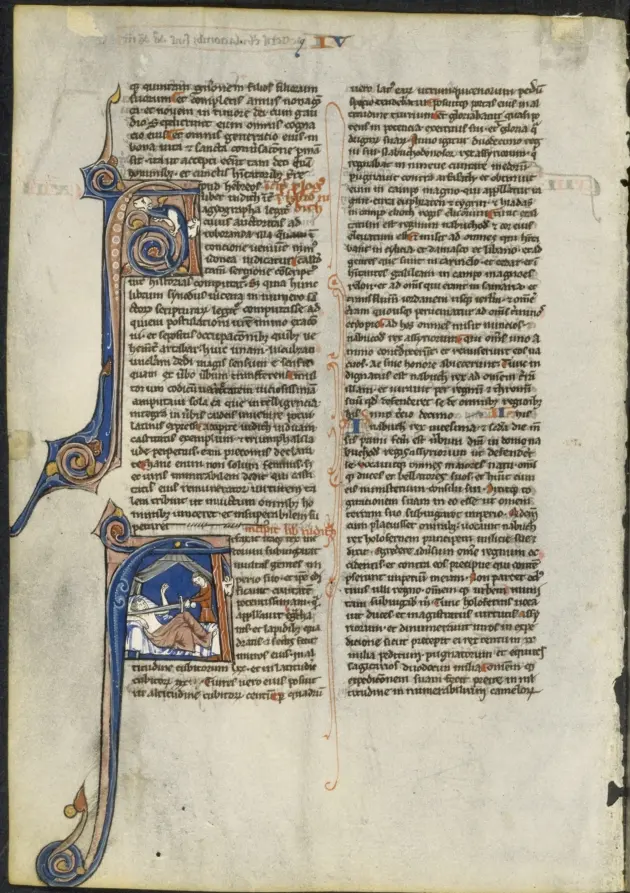
Gothic manuscript illumination · Paris
A Paris Bible makes Judith tiny but immediate: the sword crosses the initial while the sacred text continues around her.
The act
Gothic manuscript illumination · Southern France, possibly Toulouse
Compressed into a single letter, the killing becomes a legible sign of divinely assisted courage rather than an anatomy of violence.
The actMedieval typological manuscript · Italy, workshop unverified
A medieval Speculum places Judith's victory beside the Virgin overcoming the Devil: typology is built into the page, not supplied as a later gloss.
The act
Late Gothic tapestry · South Netherlands
At more than four metres high, the private handoff becomes an enveloping public spectacle woven in wool and silk.
The head in the bag
Early Renaissance · Florence
A private Medici commission became a public Florentine image of the weak overthrowing the strong—and therefore a dangerously adaptable political object.
The sword raised
Early Renaissance · Florence
Botticelli refuses the bedroom. His Judith is already in motion: lucid, wind-blown, and returning with the sword held like an attribute of office.
Return to Bethulia
Early Renaissance · Florence
The missing half of Botticelli’s pair restores the enemy camp: Judith’s graceful return has a simultaneous scene of male shock and political collapse.
Discovery of the body
Renaissance · Mantua / northern Italy
A poised exchange at the tent opening turns the severed head into an object passed between two women—and attribution remains part of the work's history.
The head in the bag
Renaissance printmaking · Venice
Engraving made Judith portable, translating a coveted Mantegnesque invention into a repeatable image that could travel without its panel.
The head in the bag
High Renaissance · Venice
A bare foot rests on the head with almost no visible effort, making pastoral calm carry the entire moral and erotic contradiction.
Display of the head
High Renaissance · Rome / Vatican City
Michelangelo splits aftermath across the tent: the women carry the burden outward while the decapitated body remains behind.
The head in the bag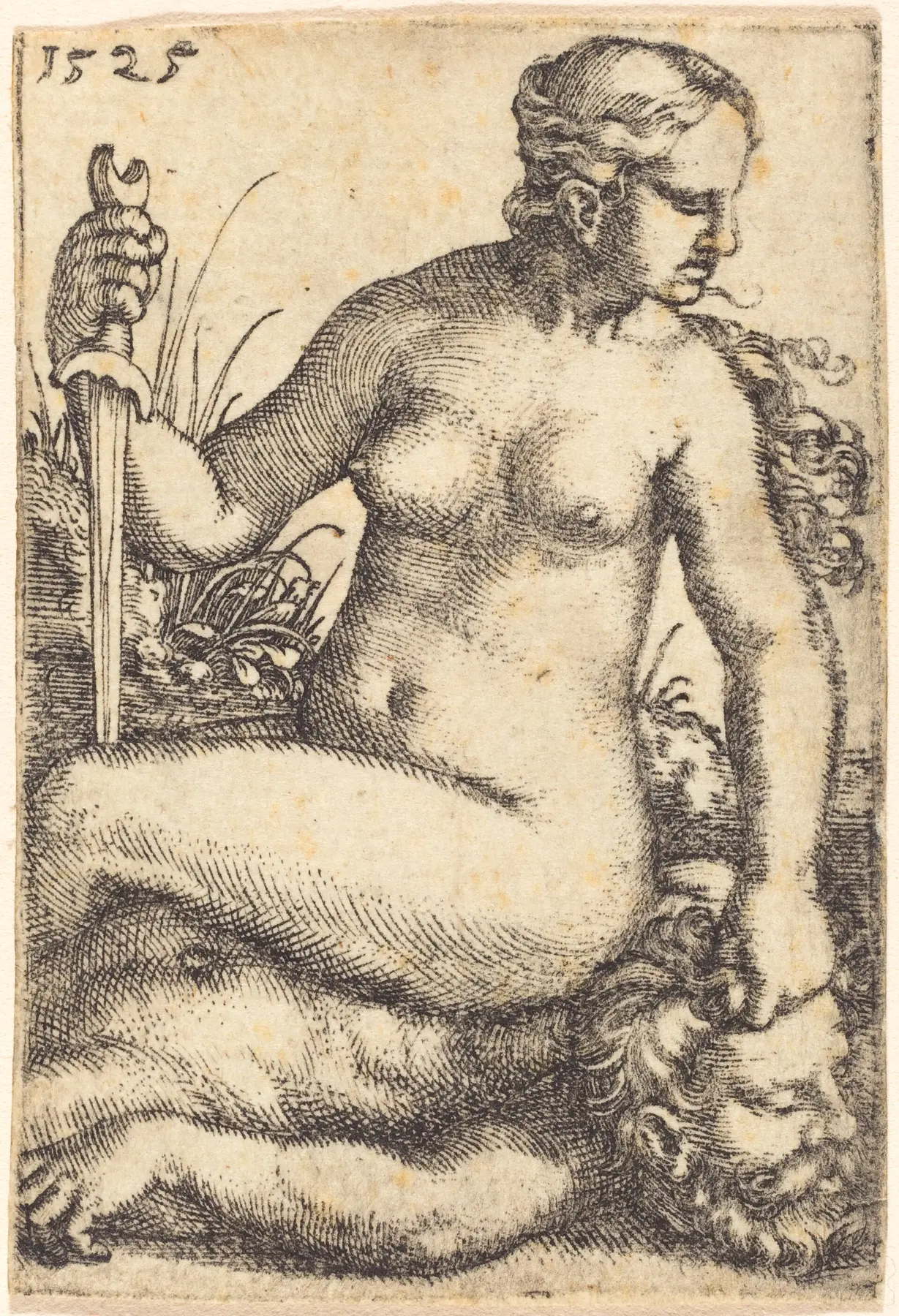
German Renaissance printmaking · Nuremberg
Barely five centimetres high, Beham's Judith becomes a portable, eroticized Power of Women emblem seated directly on the defeated body.
Display of the head
Northern Renaissance · Wittenberg
Cranach's Judith is dressed to kill: courtly surface and bodily horror coexist without disturbing her composure.
Display of the head
Northern Renaissance · Antwerp
Van Hemessen makes Judith physically imposing and disquietingly close, neither demure heroine nor effortless court beauty.
Display of the head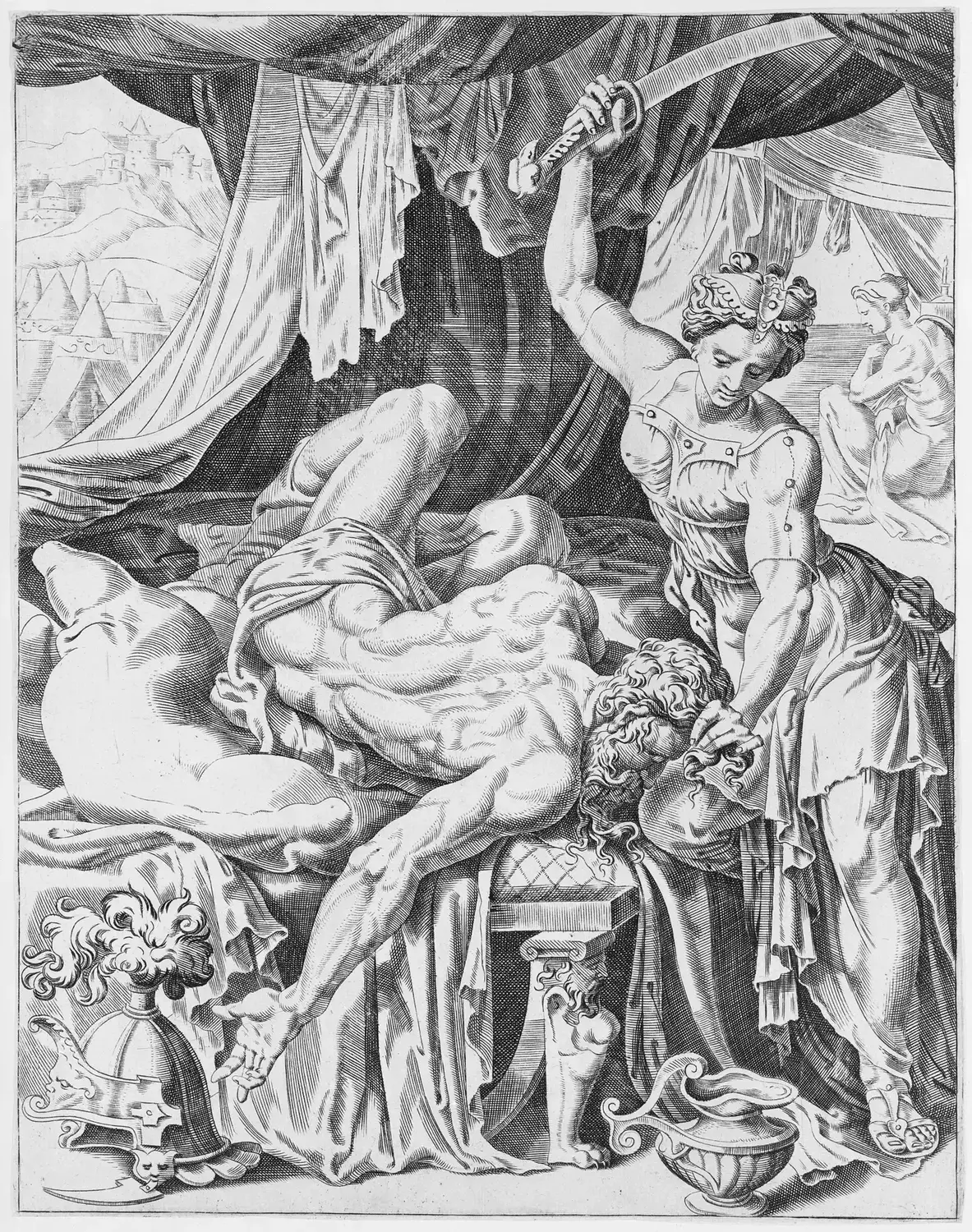
Northern Renaissance printmaking · Haarlem
Plate five explicitly places Judith inside a Power of Women series, so serial order—not only the isolated scene—controls how victory is read.
The act
Renaissance decorative arts · Germany
A biblical conqueror decorates a container made to charge firearms: Judith becomes a talisman of force held in the hand.
Display of the head
Late Renaissance · Venice
Loose paint and unstable light convert the escape into a moment of listening: both women seem to test the darkness for discovery.
Escape from the camp
Late Renaissance · Venice
Silk, pearls, and turning bodies convert aftermath into aristocratic theater. The painting hovers near portraiture without surrendering its biblical identity.
Display of the head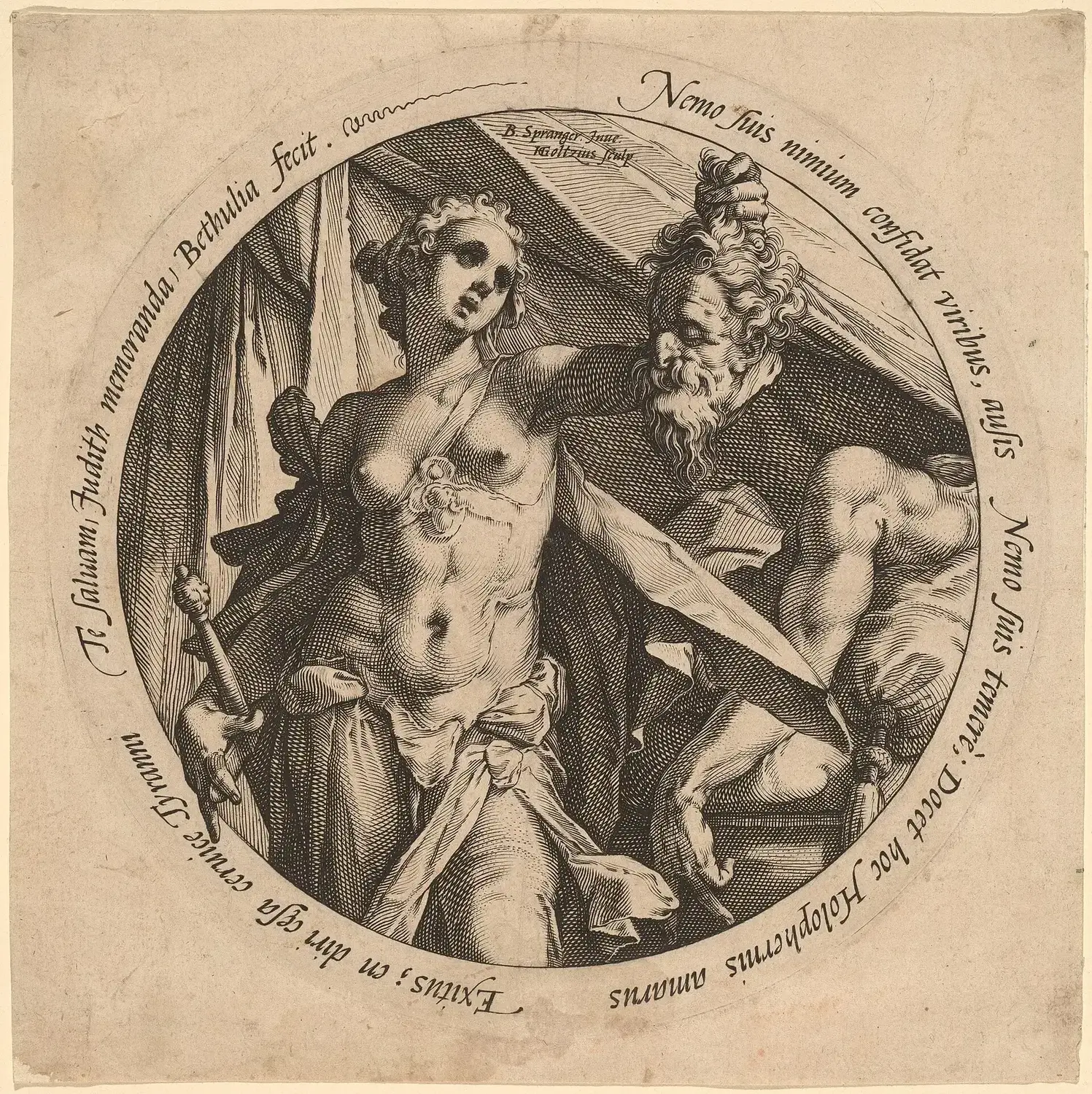
Northern Mannerist printmaking · Haarlem / Prague
Goltzius translates Spranger's courtly Mannerism into a circular engraving whose virtuoso line could carry the design far beyond Prague or Haarlem.
Display of the head
Late Renaissance · Bologna
Attribution remains open, but the painting makes clear how readily Judith could operate as a vehicle for female presence, dress, and professional authorship.
Display of the head
Baroque / Caravaggism · Rome
The story crosses a threshold: not the poised heroine after the deed, but the resistant body, working blade, and split second in which intention becomes fact.
The act
Lombard late Mannerism · Milan
Signed and dated on the sword, Galizia’s Judith joins luxurious precision to an uncompromising claim of authorship.
Display of the head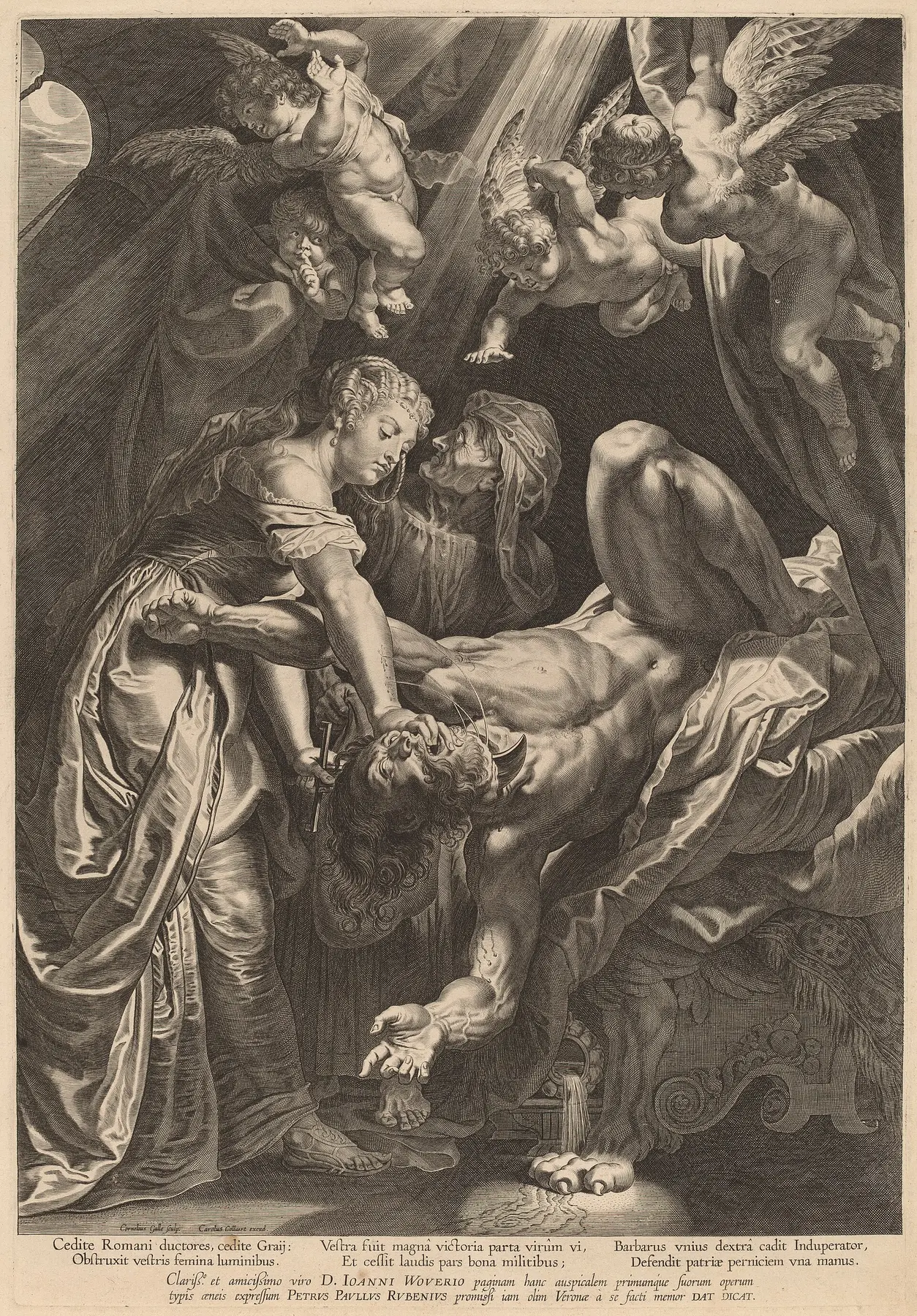
Baroque reproductive printmaking · Antwerp
A monumental engraving after Rubens translates Baroque invention into a reproducible sheet almost sixty centimetres high.
The act
Baroque · Florence
Allori turns the aftermath into a polished double portrait, long read through the artist's romantic life but never exhausted by that anecdote.
Display of the head
Baroque / Caravaggism · Rome
An unsettled attribution becomes evidence: father, daughter, workshop, and possible collaboration complicate the desire for a single authorial voice.
Escape from the camp
Baroque / Caravaggism · Rome / Naples
Two women work together at arm's length. Compressed space, crossed forearms, and bodily leverage make coordinated force the engine of the scene.
The act
Baroque / Caravaggism · Rome
The killing is over, but danger is not. A torch catches two women mid-escape, converting aftermath into nocturnal suspense.
Escape from the camp
Baroque / Caravaggism · Rome (Uffizi attribution of completion)
The Florence painting enlarges, clarifies, and intensifies the earlier composition. It is a reconsideration of light, fabric, force, and consequence.
The act
Baroque / Caravaggism · Rome
The violent act has become a study in shared attention: two women listen into darkness while the hidden head presses upward through the cloth.
Escape from the camp
Baroque / Caravaggism · Rome
The only painting securely attributed to Vezzi makes rediscovery itself part of the object: a Judith returned an artist to view.
Display of the head
Baroque / Caravaggism · Venice
Liss combines the wound, the handoff, and the hurried escape, refusing to let aftermath become clean or ceremonial.
The head in the bag
Dutch Baroque · Amsterdam
Once called Artemisia or Sophonisba, the woman is now read as Judith in the dangerous quiet before Holofernes drinks himself defenseless.
The banquet
Baroque / Caravaggism · Rome in the Walters record; chronology disputed
A hidden candle makes serene concentration and exploding horror share one diagonal, while Holofernes’s inverted face turns defeat into literal reversal.
The act
Neapolitan Baroque · Naples
Stanzione turns the aftermath into a full-length public image: Judith’s body, costume, and sword command more space than the subdued trophy.
Display of the head
French Baroque printmaking · Paris
Bosse gives the biblical tent contemporary furniture. Sacred history becomes intimate, reproducible, and available at the scale of the hand.
The act
Flemish Baroque · Southern Netherlands / Brussels
Still held in a church rather than a famous picture gallery, Wautier’s canvas makes coordinated labor quiet, close, and weighty.
The head in the bag
Bolognese Baroque · Bologna
The Walters’ cautious ‘circle of’ attribution refuses a marketable certainty and preserves the entangled visual languages of daughter, father, and workshop.
The head in the bag
Safavid Europeanizing painting · Isfahan
Judith reaches Isfahan through circulating European images, then returns transformed within a Safavid album tradition.
Display of the headNovohispanic painting · New Spain (present-day Mexico)
An anonymous painter in New Spain makes Judith part of colonial visual culture, where copying, devotion, and local workshops complicate any Europe-only story.
Display of the head
Bolognese Rococo · Bologna
At only nine centimetres high, wash and flickering pen strokes reduce Judith to an experiment in pose, weight, and silhouette.
Display of the headJewish ceremonial art · Poland
Judith crowns a household ritual lamp, moving the heroine from painted narrative into the material observance and historical imagination of Hanukkah.
Afterlife of the story
Black Paintings · Madrid
The victim disappears. Goya leaves a knife, luminous face, crouching attendant, and darkness dense enough to turn biblical action into private dread.
The sword raised
American academic painting · United States, likely Philadelphia
An American portraitist copied Allori's famous Judith at full scale, making transmission—not originality—a map-worthy fact.
Display of the head
19th-century sculpture · France
Rough clay and deep folds make victory tactile. The severed head is not painted illusion but a small volume that shares Judith’s space.
Display of the head
Victorian history painting · Britain
Herbert slows the narrative to a moral pause. Prayer, not impact, occupies the center; inward authorization precedes murder.
Before the blow
Academic history painting · Florence / Brazilian academic art
A Brazilian history painter working in Florence turns Judith into monumental academic theatre, then sends the canvas into a Rio de Janeiro collection.
Display of the head
Brazilian caricature and illustrated press · Rio de Janeiro
Four years after Pedro Américo painted Judith in Florence, Agostini pulled her into Rio's satirical press and made the academic heroine answer to public life.
Display of the head
French Orientalism · Paris
Red, gold, sword, and an absent victim turn Judith into an ‘exotic’ avenging beauty shaped by nineteenth-century Orientalist fantasy.
Display of the head
Brazilian academic painting · Brazil, studio location unverified
A second Brazilian painter translates Pedro Américo's monumental Judith into a smaller canvas whose private survival reveals another route through the tradition.
Display of the head
Vienna Secession · Vienna
Holofernes is almost edited out. Gold, exposed flesh, and Judith's half-lidded gaze transform public deliverance into an intimate, unstable encounter.
Display of the head
Vienna Secession · Vienna
Eight years after Judith I, beauty has become angular, restless, and almost predatory—and the alternate title ‘Salome’ exposes the identities viewers keep collapsing.
Display of the headChicago figurative painting · Chicago, United States
A large early Chicago painting carries Judith into postwar American figuration, well outside the Old Master sequence that usually ends the story.
The banquet and tentAmerican modernism · New York, United States
A New York sculptor's preparatory drawing makes process visible: Judith exists not only as finished icon but as a body being worked toward in another medium.
Afterlife of the storyAmerican Regionalism after 1945 · California, United States
Medearis recasts Judith through American Regionalist memory, exchanging court costume for the visual language of a careworn pioneer portrait.
Afterlife of the storyAmerican self-taught art · Florida, United States
Minchell chooses what museums often omit: not the bedroom or trophy portrait, but the military panic that Judith's proof sets in motion.
The Assyrians fleeNew Zealand narrative painting · New Zealand, studio location unverified
A New Zealand narrative painter takes up Judith at the start of a survey spanning four decades, placing the story inside a sustained argument about local identity.
Afterlife of the storyNew Zealand narrative painting · New Zealand, studio location unverified
A separately titled 1982 entry adds the street, inviting the possibility that Brown moved Judith from isolated biblical drama into a contemporary public world.
Afterlife of the storyPostmodern photography · Place of making unverified; series begun in Rome
Sherman performs Judith through thrift-store splendor, prosthetic artifice, and the giant scale of an Old Master portrait translated into photography.
Afterlife of the storySots Art / postmodernism · New York, United States
Two Russian-American artists relocate Judith to the symbolic center of Soviet power, turning decapitation into postmodern historical theater.
Afterlife of the storyContemporary feminist painting · Minneapolis, United States
Blondell answers Klimt, Caravaggio, and centuries of male depiction with a Judith who looks fully committed to the mission she chose.
Display of the headContemporary portraiture · Brooklyn, New York, United States
A powerful Black woman in Givenchy holds the severed head of a White woman, forcing race, gender, beauty, and museum power into the old script.
Display of the headContemporary abstraction · Melbourne, Australia
Hundreds of layers of color abstract Caravaggio's Judith until narrative bodies disappear but the source's chromatic and emotional pressure remains.
Afterlife of the storyContemporary material painting · Sydney, Australia
Sharp reduces the story to two small material panels, using green earth, wax, and the diptych form to ask what remains when painting becomes object and residue.
Afterlife of the storyContemporary abstract figuration · Thailand
A Thai artist pours Artemisia's violent composition into an abstract language, treating reproduction as a means of recognition and return.
The actScholarship, exhibitions, and conservation restore Artemisia Gentileschi's authorship and importance, while debate continues over biography and interpretation.