c. 100 BCE
Movement 01
A heroine written against empire
Historical fiction or theological novella creates a reusable story of fidelity under occupation.
See the chronology →A visual argument
The same narrative has served devotion, civic liberty, court display, political satire, erotic fantasy, feminist revision, and critiques of race and museum power. The shifts are historical claims to test against objects, not proof of a single evolutionary path.
Not a march from faith to sex. Not a neat replacement of heroine by monster. Meanings accumulate, retreat, and return.
Movement 01
Historical fiction or theological novella creates a reusable story of fidelity under occupation.
See the chronology →Movement 02
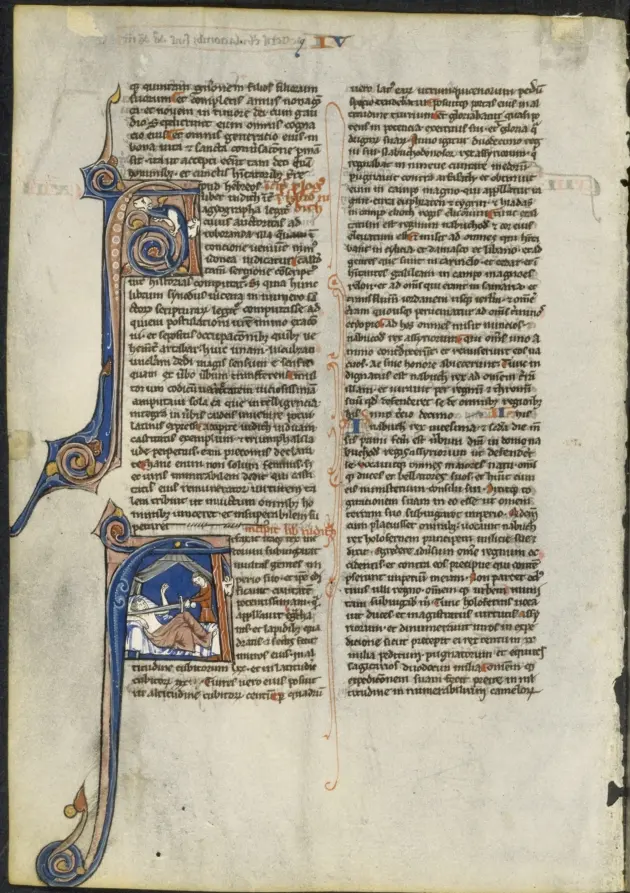
Judith models chastity, humility, courage, and divine victory. In the Fitzwilliam Speculum, her defeat of Holofernes is paired on the page with the Virgin overcoming the Devil.
See the chronology →
Movement 03
Italian cities make Judith politically visible, especially in Florence, where liberty depends on who controls the image.
See the chronology →
Movement 04
Court dress and portrait conventions bring serene beauty and bodily horror into unresolved proximity.
See the chronology →
Movement 05
Caravaggio and his wake force attention onto labor, resistance, blood, and shared action.
See the chronology →
Movement 06
Goya's private darkness and Klimt's eroticized icon are not the whole century. Herbert remains devotional; Américo is academic and transatlantic; Agostini turns Judith into satire; Benjamin-Constant stages spectacle. Friedrich Hebbel's 1840 tragedy helps explain the period's psychological turn without making it universal.
See the chronology →Movement 07
Modern and contemporary artists return through postwar figuration, photography, abstraction, Black portraiture, feminist revision, national history, and parody. Feminist scholarship recovers Artemisia while also debating how biography, form, patronage, and reception should share explanatory weight.
See the chronology →Words around the images
The incomplete Old English Judith, preserved in the Nowell Codex after Beowulf, turns the heroine into vernacular heroic poetry. Friedrich Hebbel's 1840 tragedy later transforms the political story into a psychological and sexual conflict that matters to nineteenth-century reception.
Neither text supplies a master key for every artwork. Together they show why a visual timeline that jumps directly from scripture to painting misses part of the machinery by which Judith changed. Read the interdisciplinary scholarship in The Sword of Judith ↗
Media change the argument
Mocetto after Mantegna made a coveted gesture portable; Barthel Beham compressed Judith into a collectible Power of Women emblem; and Coornhert after Heemskerck numbered her within a series. Goltzius after Spranger carried a Prague design through Haarlem, while Galle after Rubens made reproductive engraving monumental. Bosse's etching extends the route. Prints create networks of invention, copying, reversal, reuse, and recognition; those networks are part of the subject's history.
Counter-Reformation painting likewise cannot be reduced to a neutral continuation of Renaissance iconography. Judith could operate as Catholic orthodoxy, female exemplarity, devotional drama, and spectacular violence at once. Elena Ciletti's focused study provides the larger Counter-Reformation frame ↗
An iconographic collision
Both can appear as beautiful women with a severed male head and an attendant. Yet the narrative roles oppose one another. Judith plans and performs a tyrant's death to save her city; Salome receives John the Baptist's head after her dance, at another person's instigation.
As artists suppress swords, sacks, settings, or attendants, the two images can approach each other. Fin-de-siècle culture exploited the ambiguity. In Klimt's Judith I, the metal frame itself insists on JUDITH UND HOLOFERNES even as critics repeatedly called the figure Salome. Careful attribution requires objects and sources—not simply recognizing “woman plus head.”

Modern reception
Mary Garrard’s feminist reading made the heroine and the painter newly visible. Griselda Pollock contests the rape-as-master-key from within feminist and psychoanalytic reading practice: what matters includes how art history teaches us to read gendered images. R. Ward Bissell approaches Artemisia through documentary connoisseurship, chronology, attribution, and patronage, an approach often criticized for underweighting gender. These are not one correction but a three-cornered argument.
The rape and 1612 trial belong to that reception history, but no single biographical or anti-biographical formula explains the paintings.